Lernevate Team
Lernevate Contributor
Personalized learning paths enterprise complexity explained: why truly individualizing training for hundreds of employees creates unnecessary operational overhead — and what to do instead.
Personalized learning paths enterprise complexity is a solvable problem: a 5-section evaluation produces just 32 unique path combinations — regardless of headcount. Managing 32 templates instead of thousands of individual assignments is the operational shift that makes personalization scalable.
The solution isn't less personalization. It's smarter personalization.
The Small-Scale Illusion
With 50 employees or fewer, manual personalization works beautifully. You assess individual needs, assign relevant courses, and adjust on the fly. The overhead is negligible.
But as organizations scale, most L&D teams make a critical mistake: they continue thinking about personalization as thousands of individuals rather than dozens of combinations.
Understanding the Real Scale of Personalization
Here's where the math gets interesting—and revealing.
Let's say you're using an evaluation (whether an assessment or a combination of attributes like role, department, and specialization) with 5 sections. Each section determines training needs:
-
Pass = optional eLearning
-
Fail = required eLearning + ILT
How many unique learning paths do you actually need to create?
The answer: 32 combinations (2^5).
Not 500 paths for 500 employees. Not 2,000 paths for 2,000 employees. Just 32.
The Operational Shift That Changes Everything
This realization fundamentally changes how you approach personalized learning at scale. Instead of creating individual paths that happen to be identical, you:
-
Define the finite set of meaningful variations upfront
-
Build reusable learning path templates for each combination
-
Route learners to their appropriate existing path based on their evaluation results
-
Maintain and update 32 paths, not thousands of redundant individual assignments
When you update content, you update it once per path variation. When you troubleshoot issues, you're debugging a system, not individual cases. When you report on compliance, you're tracking patterns across defined paths.
Visualizing the Complexity
We've built a simple Learning Path Combination Visualizer to help L&D teams visualize this concept. By adjusting the number of evaluation sections and learners, you can see exactly how many unique path combinations you're actually dealing with—and how that number stays remarkably manageable even as your organization grows.
Check it out here.
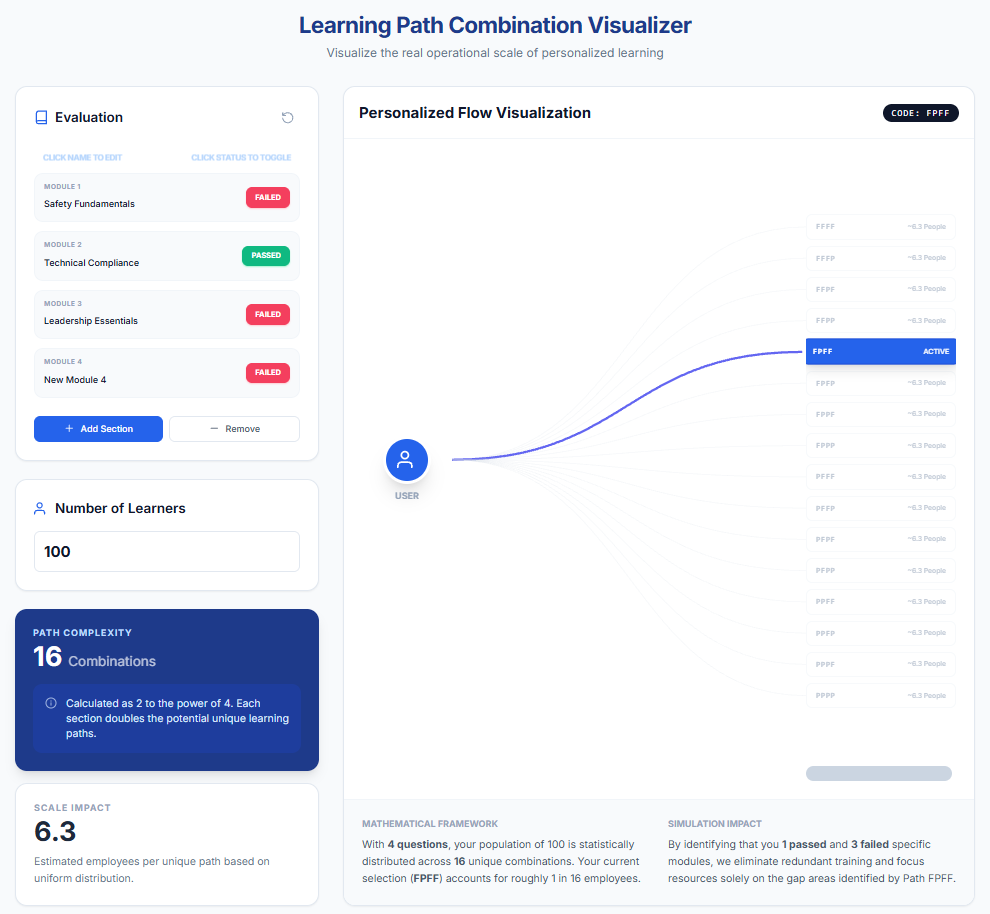
[Visual reference: The visualizer shows that whether you have 100 or 10,000 employees, 4 evaluation sections still only create 16 possible learning paths]
The Strategic Questions
This combination-based approach doesn't eliminate all complexity, but it focuses your operational energy where it matters:
-
How many evaluation sections do we actually need? (Each doubling of sections doubles your path variations)
-
What's the meaningful difference between paths? (Not every variation requires a completely different learning journey)
-
Can we group similar needs? (Maybe 3-4 sections capture 90% of what matters)
-
Do we have the infrastructure to route learners automatically? (The operational benefit only materializes with proper systems)
From Operational Nightmare to Strategic Asset
The difference between thinking individually versus in combinations is the difference between:
-
Creating the same learning path 47 times for 47 different people in the same role
-
Creating it once and assigning those 47 people to code "FFPPF"
-
Updating 47 individual assignments when content changes
-
Updating one path template that automatically applies to all 47
-
Generating 47 separate completion reports
-
Running one report filtered by path variation
The Bottom Line
Personalized learning at scale isn't about treating every employee as completely unique. It's about recognizing that there are a finite number of meaningful training needs in any organization, and building your operational infrastructure around that mathematical reality.
When you shift from thinking about 1,000 individuals to thinking about 32 combinations, personalization stops being an operational burden and starts being what it should be: a strategic advantage.
Frequently Asked Questions
How many unique learning paths does a large enterprise actually need?
Far fewer than most teams assume. With 5 evaluation sections each producing a pass/fail outcome, you have exactly 32 unique path combinations — regardless of whether you have 500 or 50,000 employees. The number of combinations is determined by your evaluation structure, not your headcount.
What is the operational benefit of thinking in combinations instead of individuals?
When you maintain 32 path templates instead of thousands of individual assignments, content updates apply once per template, compliance reports track patterns across defined paths, and troubleshooting targets a system rather than individual cases.
What LMS infrastructure is needed to route learners to the right path automatically?
You need a reliable user attribute or group structure that maps to your evaluation outcomes, and a dynamic assignment rule in your LMS that triggers based on that attribute. Cornerstone's User Groups + Learning Assignments and Docebo's enrollment rules both support this pattern.
If your organization needs help designing a scalable learning path architecture or selecting the right LMS to support it, explore our Strategic Advisory services. For the operational implementation — routing logic, assignment setup, and maintenance — see our LMS Administration services or our Automation Services for teams who need the assignment routing built out programmatically.
Related Topics: